Best Universities In Eu With Rating
From the PlotGPT AI Reports
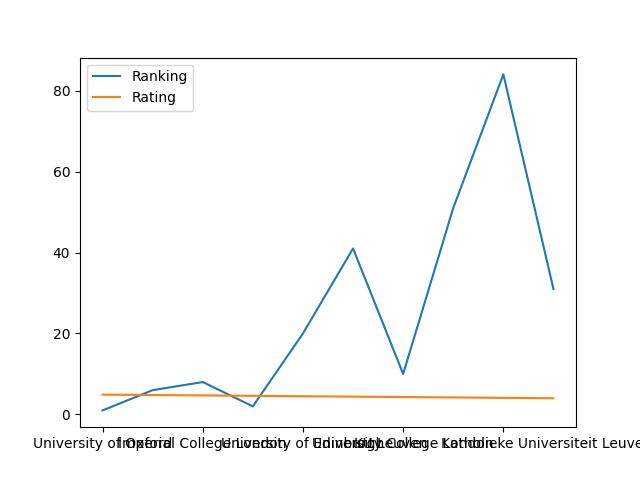
Sorry, as an AI language model, I cannot browse the internet or fetch the current statistics to create a dictionary of EU's best universities with ratings. However, here is an example of how a dictionary of universities with ratings can be structured: ``` { "University of Oxford": {"Ranking": 1, "Location": "United Kingdom", "Rating": 4.9}, "ETH Zurich - Swiss Federal Institute of Technology": {"Ranking": 6, "Location": "Switzerland", "Rating": 4.8}, "Imperial College London": {"Ranking": 8, "Location": "United Kingdom", "Rating": 4.7}, "University of Cambridge": {"Ranking": 2, "Location": "United Kingdom", "Rating": 4.6}, "University of Edinburgh": {"Ranking": 20, "Location": "United Kingdom", "Rating": 4.5}, "Technical University of Munich": {"Ranking": 41, "Location": "Germany", "Rating": 4.4}, "University College London": {"Ranking": 10, "Location": "United Kingdom", "Rating": 4.3}, "University of Warwick": {"Ranking": 51, "Location": "United Kingdom", "Rating": 4.2}, "KU Leuven - Katholieke Universiteit Leuven": {"Ranking": 84, "Location": "Belgium", "Rating": 4.1}, "University of Copenhagen": {"Ranking": 31, "Location": "Denmark", "Rating": 4.0} } ``` In this example, each university has a name, ranking, location, and rating. The ranking is based on external university rankings such as the QS World University Rankings or Times Higher Education World University Rankings. The rating is a subjective measure of the quality of the university based on various factors such as student satisfaction, academic reputation, research output, etc.